Florence · Deciding guide
Uffizi vs Accademia: The Difference and Which to Choose
One holds the David, the other Botticelli's Venus. One takes two hours, the other demands at least four. Here's an honest comparison to help you decide — or to see how to do both.
Independent guide This is not the official Galleria dell'Accademia website. We are an independent guide: tickets are sold by authorised resellers such as Tiqets and Headout. Facts verified against the official site galleriaaccademiafirenze.it.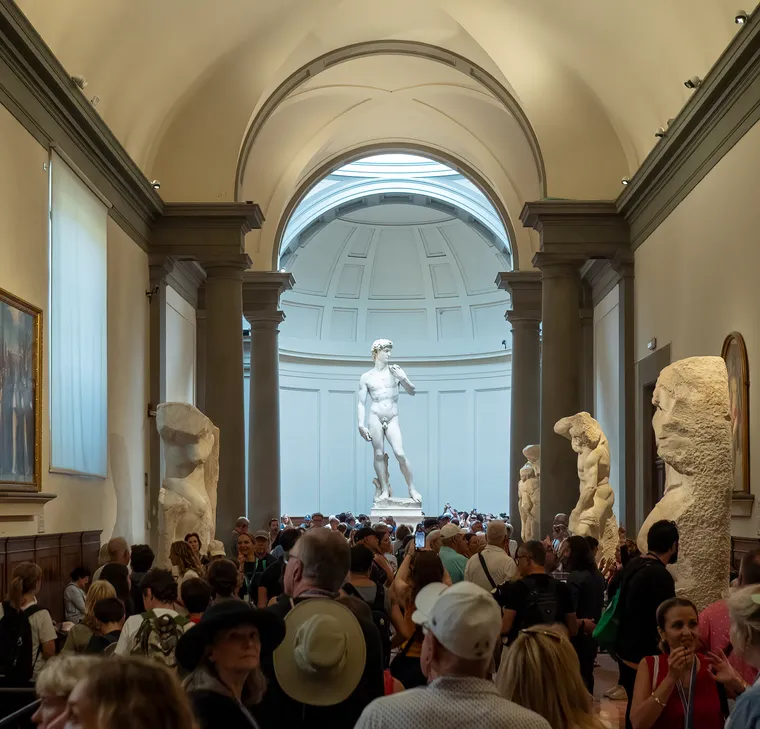
Compare options
Available tickets & packages
Room 01 · Two different museums
What the two museums really are
The question "Uffizi or Accademia?" grows out of an understandable mix-up: they are the two most-visited museums in Florence, often mentioned in the same breath. But they do very different jobs, and once you see that, the choice becomes much easier.
The Galleria dell'Accademia: one absolute masterpiece, one compact museum
The Accademia is built — literally — around Michelangelo's David: the Tribuna that houses it was designed specifically for it. Around the David there's far more than hurried visitors ever notice: the four unfinished Prisoners, showing Michelangelo's working method frozen mid-carve; the world's largest collection of gold-ground panels, the gilded paintings of the 1300s and 1400s; the Gipsoteca Bartolini with hundreds of nineteenth-century plaster models; and the Museum of Musical Instruments, with a Stradivari cello from the Medici collection.
The practical point: it's a small museum. 1–2 hours are enough to see all of it without rushing.
The Uffizi: one of the world's great painting galleries
The Uffizi is a different category of experience: dozens of rooms covering painting from the Middle Ages to the 1600s. It has Botticelli's Birth of Venus and Primavera, works by Leonardo, Raphael, Titian and Caravaggio — a list that alone explains why it's counted among the great painting museums of the world.
The flip side is time: a visit that isn't a sprint takes at least 3–4 hours, and painting lovers spend the whole day there. Leaving the Uffizi after an hour means you've seen a fraction of the museum.
Room 02 · The comparison
Uffizi and Accademia side by side
| Criterion | Galleria dell'Accademia | Uffizi Galleries |
|---|---|---|
| Signature work | Michelangelo's David (the original) | Botticelli's Birth of Venus and Primavera |
| What else is there | Unfinished Prisoners, gold-ground panels, Gipsoteca, musical instruments | Leonardo, Raphael, Titian, Caravaggio and centuries of painting |
| Size | Small: one linear route | Large: dozens of rooms over several floors |
| Realistic visit time | 1–2 hours | 3–4 hours minimum |
| Full-price ticket | €20 (+€4 online booking fee) | About €25 — check the official website |
| Booking | Near-essential in season | Near-essential in season |
| Weekly closing day | Monday | Monday |
| Best for | First time in Florence, tight schedules, families | Painting lovers, anyone with a full half-day |
Room 03 · Prices and queues
Costs and booking pressure
On price it's nearly a tie. The Accademia's full ticket is €20, plus a €4 booking fee if you buy online through the official channel; the details, discounts included, are on our ticket prices page. The Uffizi costs about €25 — the exact figure needs checking on the official Uffizi website, which also applies different rates by season.
On queues, though, the two museums share the same problem with different dynamics. The Uffizi absorbs more people because it's huge, but the entry queue without a booking stays long almost all year. The Accademia is small: admissions are capped, the best time slots vanish first, and anyone who turns up ticketless in high season faces waits of over two hours.
The practical consequence is the same for both: book a timed entry, whichever museum you choose. For the Accademia, the first slot of the morning is the one to take — the opening hours start at 8:15 am — when the Tribuna is still breathable.
Ready to book?
Pick a date and time slot with instant confirmation and a mobile ticket.
Room 04 · The choice
Which to pick if you only have time for one
There's no single right answer — only the right answer for your trip. Four concrete scenarios.
First time in Florence
Accademia. The David is the image you've carried all the way here, and seeing it in person keeps the promise: no reproduction prepares you for its 5.17 metres. And the short visit leaves room for the rest of the city, which on a first trip matters as much as the museums.
Travelling with children
Accademia. One strong, simple story — the giant carved from a single block of marble — and a museum that ends before the patience does. The musical instruments, with pieces by Cristofori, the inventor of the piano, work well as a finale.
You love painting
Uffizi. If Botticelli, Leonardo and Caravaggio are the reason for the trip, the choice is made: no other museum in Florence comes close on painting. Budget the half-day and book the first slot of the morning.
You only have two hours
Accademia. It's the only one of the two you can see in full in that time. Two hours at the Uffizi is a frustrating dash between the headline rooms; two hours at the Accademia is a complete, well-paced visit.
Room 05 · The third way
The smart answer: both in one day
Here's the fact that changes the terms of the dilemma: the two museums are about a 12-minute walk apart, and the Accademia's short visit dovetails perfectly with the Uffizi's half-day.
The tried-and-tested formula: Accademia at the first slot of the morning (1–2 hours, the David with a thin crowd), a stroll down to Piazza della Signoria, a lunch break, and the Uffizi in the early afternoon with a booked entry time. Combination tickets with timed entry to both museums exist too: the whole plan, with suggested times and buying options, is in our guide to the Uffizi and Accademia in one day.
The only requirement is discipline on the timings: book the two slots badly and you'll spend the day running. Book them well and in a single day you'll see the best of Renaissance sculpture and painting.
Room 06 · Mix-ups
The most common confusions, cleared up once and for all
"The David is in the Uffizi"
No. The original David has been at the Galleria dell'Accademia since 1873, when it was moved indoors to protect it after nearly four centuries in the open; the Tribuna built to receive it opened to the public in 1882. It was never in the Uffizi. Visitors who walk into the Uffizi expecting the David leave disappointed — it happens more often than you'd think.
"I saw the David in Piazza della Signoria"
That's a marble copy, placed in 1910 on the spot in front of Palazzo Vecchio where the original stood from 1504 to 1873. It's a good copy, but the difference in person is stark: the quality of the surface, the light of the Tribuna and the detail of the Carrara marble belong only to the original on Via Ricasoli.
"Accademia and Uffizi are the same circuit — one ticket covers both"
No: they are separate state museums, with separate ticket offices and bookings. A ticket for one does not admit you to the other. There are, however, combination tickets sold as a single package by authorised resellers, with an entry time for each museum: the convenient route for the double day.
FAQ
Frequently asked questions
What is the main difference between the Uffizi and the Accademia?
The Uffizi is one of the world’s great painting galleries: art from the Middle Ages to the 1600s, dozens of rooms, 3–4 hours minimum. The Accademia is a small museum built around one absolute masterpiece, Michelangelo’s David: you can see it all in 1–2 hours.
Is Michelangelo’s David in the Uffizi?
No — it's one of the most common mix-ups. The original David has been at the Galleria dell'Accademia since 1873, in the Tribuna built for it. In Piazza della Signoria, in front of Palazzo Vecchio, stands a marble copy placed there in 1910. The full story is in our guide to the David.
Which of the two museums costs more?
The official prices are close: the Accademia costs €20 (plus a €4 online booking fee), the Uffizi about €25 — check the exact figure on the official Uffizi website, which also applies seasonal rates. In both cases, resellers with priority entrance cost more than the ticket-office price.
I only have two hours: which should I pick?
The Accademia, without hesitation. In two hours you can see the whole museum at a comfortable pace, David included. The same two hours at the Uffizi barely cover a taste of a few rooms, and you’ll feel like you were running the whole time.
Can you visit the Uffizi and the Accademia on the same day?
Yes — and it's the most efficient plan if you're short on time: they're about a 12-minute walk apart. The formula that works is the Accademia early in the morning, then the Uffizi, both with booked entry times. We walk through it step by step in our guide to the Uffizi and Accademia in one day.
Which of the two is better with children?
The Accademia: a short visit, one star attraction that’s easy to explain, and the Museum of Musical Instruments to intrigue even the youngest. The Uffizi — long and crowded — will test any child’s patience.
Do I need to book for both museums?
In high season, yes, for both. They are the two most-visited museums in Florence and the queues without a booking easily exceed an hour. For the Accademia, prices and where to buy are covered in this guide; for the Uffizi, book through the official channels or authorised resellers.