Museum guide · Room by room
Accademia Gallery Artworks, Room by Room
The David is why you go in — but not why you stay: unfinished Prisoners, fourteenth-century gold-ground panels, a hall full of plaster casts and the Medici Stradivari. Here is what to see, and in what order.
Independent guide This is not the official Galleria dell'Accademia website. We are an independent guide: tickets are sold by authorised resellers such as Tiqets and Headout. Facts verified against the official site galleriaaccademiafirenze.it.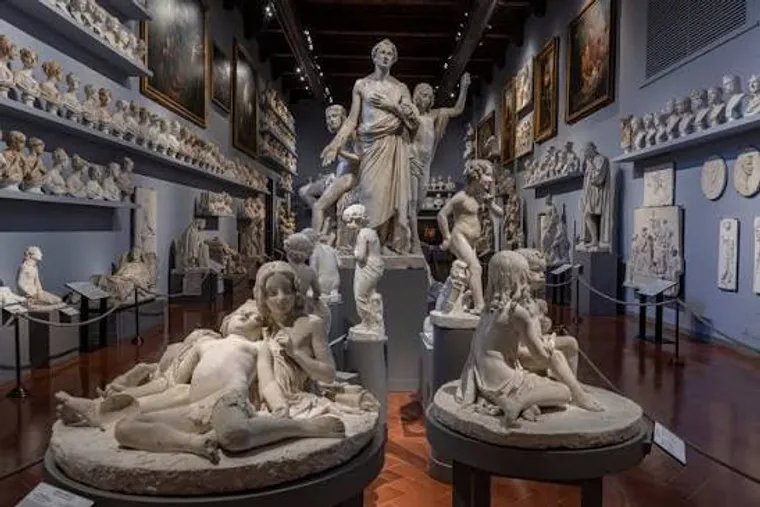
Compare options
Available tickets & packages
Room 00 · Getting oriented
A small museum with five souls
The Galleria dell'Accademia was founded in 1784, when Grand Duke Pietro Leopoldo set it up as a teaching collection for students of the Accademia di Belle Arti, which still occupies the building next door. That origin explains the museum's character: not an encyclopaedic collection, but a set of very different sections — sculpture, gold-ground painting, nineteenth-century plaster casts, musical instruments — gathered under one roof on Via Ricasoli.
The good news is that a single ticket covers it all, in 1–2 hours. This table sums up the route; each section is described in turn below.
| Section | Don't miss | Suggested time |
|---|---|---|
| Sala del Colosso | Giambologna's model for the Rape of the Sabine Women | 10–15 min |
| Galleria dei Prigioni | Michelangelo's four Prisoners and his St Matthew | 15–20 min |
| Tribuna | The David | 20–30 min |
| Gipsoteca Bartolini | Hundreds of plaster casts by Bartolini and Pampaloni | 10–15 min |
| Gold-ground panels & the 1400s | The Tree of Life, the Cassone Adimari, Botticelli | 15–25 min |
| Musical instruments | Stradivari cello and viola, Cristofori | 10–15 min |
Room 01 · Sala del Colosso
Giambologna and the altarpieces of the 1400s
The first room on the route takes its name from the giant group at its centre: Giambologna's full-size plaster model for the Rape of the Sabine Women, the preparatory cast for the marble that stands under the Loggia dei Lanzi in Piazza della Signoria. Seeing the model before (or after) the original in the square is a free little lesson in how a sculpture came into being: here you can circle the spiralling composition at your leisure, with no traffic.
The walls are an anthology of fifteenth-century Florentine painting: altarpieces by Botticelli, Perugino and Filippino Lippi. It is the room most visitors cross in two minutes on their way to the David: give it ten, on the way in or on the way out.
Room 02 · Galleria dei Prigioni
Unfinished Michelangelo: the Prisoners and the St Matthew
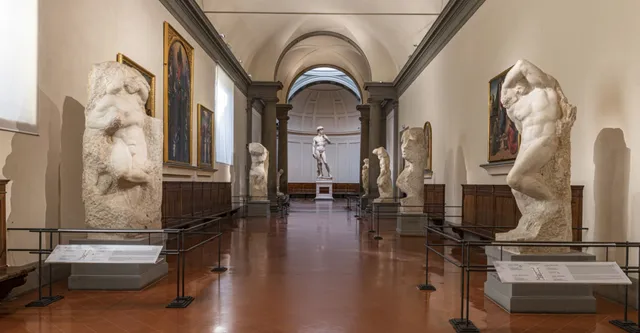
The corridor leading to the Tribuna is, for many, the most moving part of the museum. Along its sides stand the four Prisoners (Prigioni) — the Young Slave, the Bearded Slave, the Atlas and the Awakening Slave — figures carved for the tomb of Pope Julius II and never finished, at the Accademia since 1909. The bodies emerge half-formed from the rough marble, chisel marks still visible: no other work shows Michelangelo's method so plainly — he spoke of "freeing" the figure already contained in the block.
The same gallery holds the St Matthew, also unfinished, and the Palestrina Pietà, whose attribution to Michelangelo scholars have long debated: look at it knowing the label is more cautious than the fame. At the end of the perspective, framed by the arch of the Tribuna, the David appears — the full story is in our guide to Michelangelo's David.
Room 03 · Tribuna
The David in the room built for it
The Tribuna was designed by the architect Emilio De Fabris specifically for the David, which arrived from Piazza della Signoria in 1873; the room opened to the public in 1882. Under the skylight, the 5.17 metres of Carrara marble carved between 1501 and 1504 remain the one true reason this museum has a queue: walk the full circle around the statue, study both profiles, and don't settle for the frontal photo. The statue in the piazza, there since 1910, is a copy; the original is only here.
Book before you pick a favourite room
One ticket covers every section of the museum, David included. Instant confirmation, ticket on your phone.
Room 04 · Gipsoteca Bartolini
The hall of plaster casts the tour groups never see
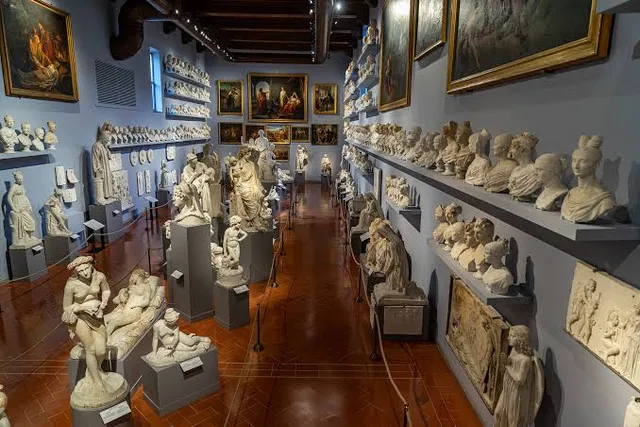
To the far left of the Tribuna opens the Salone dell'Ottocento, home to the Gipsoteca Bartolini: hundreds of plaster models from the workshops of Lorenzo Bartolini and Luigi Pampaloni, the two leading figures of nineteenth-century Florentine sculpture. Busts, funerary monuments, portraits of the European aristocracy: a white, silent crowd that is part studio storeroom, part museum within the museum.
It is the most photogenic section after the Tribuna, and the one nearly every tour skips for lack of time. The dark dots you see on many of the casts are "repère" points — the reference marks used to transfer measurements from model to marble. Look for them, and the room stops being a row of busts and becomes a manual of technique.
Room 05 · Gold-ground panels
The 1300s: the Tree of Life and Giotto's school
The rooms of fourteenth-century painting hold what is, by some counts, the world's largest collection of gold-ground panels ("fondi oro"): paintings on gilded backgrounds, ranging from the school of Giotto to the late Gothic of Lorenzo Monaco. The gold is not decoration but language: it stands for divine light, outside time and space.
The piece to seek out is Pacino di Bonaguida's Tree of Life: a painted tree whose branches carry dozens of small medallions telling the stories of Christ, to be read from bottom to top like a theological comic strip. It alone justifies the ten minutes almost nobody gives these rooms.
Room 06 · The 1400s
The Cassone Adimari and Florence in party dress
The fifteenth-century rooms tell the story of the Florence of merchants and weddings. The star is Lo Scheggia's Cassone Adimari: a wedding-chest panel showing a procession of ladies and gentlemen in dazzling brocades in front of the Baptistery. It is the most vivid record of how the city dressed — and celebrated — in the early Renaissance, and the detail in the fabrics deserves a magnifying glass.
Around it hang more works by Botticelli and Ghirlandaio, reaching as far as Bronzino: a quick but high-quality survey of Florentine painting between the 1400s and 1500s — useful as an appetiser (or a recap) for the Uffizi.
Room 07 · Musical instruments
The Medici Stradivari and the first piano
The final section surprises anyone who isn't expecting it: around 50 instruments from the Medici and Lorraine collections, the legacy of court collecting. The headline pieces are a cello and a viola by Antonio Stradivari that belonged to the so-called "Medici quintet", brought to Florence for the grand-ducal court and preserved in extraordinary condition.
Alongside them are instruments by Bartolomeo Cristofori, the court harpsichord maker who invented the piano here in Florence: you can see up close the technical leap from the harpsichord to the "gravicembalo col piano e forte". Ten minutes well spent, especially if you travel with someone who plays.
Room 08 · In practice
How to plan your visit to the artworks
Everything you have just read is covered by one single ticket: €20 full price, €2 reduced for EU citizens aged 18–25, plus €4 for official online booking; resellers such as Tiqets start at about €31, with prices varying by date. The full picture, including the combinations with the Bargello, is on the ticket prices page; in high season a timed skip-the-line entry is worth it either way.
Short on time (1 hour)
Sala del Colosso at a brisk pace, the Prisoners unhurried, the Tribuna, then the Gipsoteca to finish. Gold-ground rooms and instruments only if time remains.
Full visit (2 hours)
Every section in the order of this guide, with the audio guide for the paintings and instruments: on-site rental costs €6 with an ID document as deposit.
On your own or on a tour?
A guided tour gives you the context on the David and the Prisoners but usually skips the Gipsoteca, the gold-ground rooms and the musical instruments. If you want the whole museum, go on your own with the audio guide.
FAQ
Frequently asked questions
What are the most important artworks at the Galleria dell’Accademia?
Michelangelo's David in the Tribuna, the four Prisoners and the St Matthew in the entrance gallery, Giambologna's plaster model for the Rape of the Sabine Women in the Sala del Colosso, Pacino di Bonaguida's Tree of Life among the gold-ground panels, Lo Scheggia's Cassone Adimari, and the Stradivari instruments from the Medici collection. The full story of the David is in our dedicated guide.
How long does it take to see all the artworks?
Between 1 and 2 hours. The museum is compact: the Tribuna and the Prisoners take a well-spent half hour, and the rest — the paintings, the Gipsoteca and the musical instruments — fills the following hour, depending on your interests.
Does the entry ticket include every room?
Yes. A single ticket covers the entire museum: the David, the Prisoners, the painting collection, the Gipsoteca Bartolini and the Museum of Musical Instruments. There are no separate tickets by section: prices and discounts are on the prices page.
What is the best order to visit in?
If you enter early, head straight for the Prisoners and the Tribuna before the groups arrive, then double back for the Sala del Colosso and carry on with the Gipsoteca, the gold-ground rooms and the musical instruments. In the middle of the day, reverse the order: the smaller rooms first, then the David as the groups thin out.
What do guided tours usually skip?
Almost always the Gipsoteca Bartolini, the gold-ground rooms and the Museum of Musical Instruments: on a one-hour tour, the time goes to the David and the Prisoners. If those sections interest you, visit the museum on your own or stay on after the guided part.
Are there paintings by Botticelli at the Accademia?
Yes. The painting collection holds works by Botticelli, alongside Perugino, Filippino Lippi, Ghirlandaio and Bronzino. Just don’t expect his most famous pieces: the Primavera and the Birth of Venus are at the Uffizi.
Is the audio guide worth it for the artworks?
On a first visit, yes — especially for the paintings and the musical instruments, where the labels are minimal. It rents at the bookshop for €6, with an ID document left as a deposit; the digital alternatives are on the audio guide page.