Artwork guide · The Tribuna
The David Statue at the Accademia Gallery
How a marble block abandoned by two sculptors became the most famous statue in the world: the history, the numbers, the restorations, and the right way to look at it in the Tribuna.
Independent guide This is not the official Galleria dell'Accademia website. We are an independent guide: tickets are sold by authorised resellers such as Tiqets and Headout. Facts verified against the official site galleriaaccademiafirenze.it.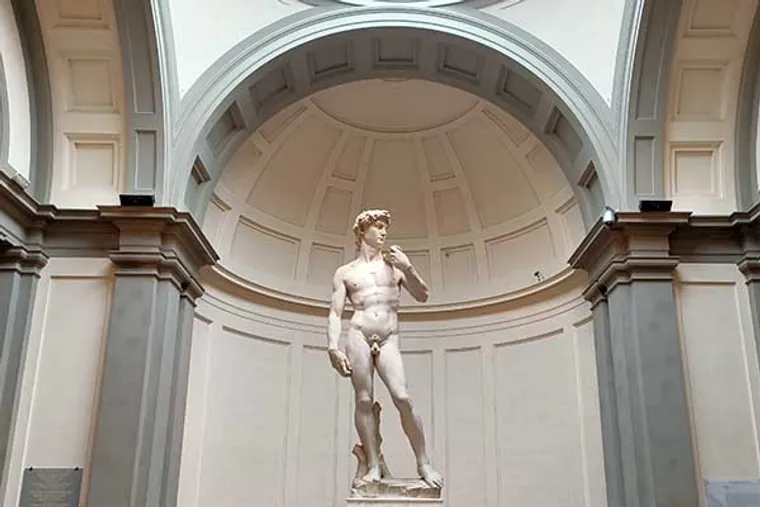
Compare options
Available tickets & packages
Room 01 · The commission
The block nobody had managed to carve
The David was born of someone else's failure. The Opera del Duomo — the body that ran the building works at Florence's cathedral — owned an enormous block of Carrara marble, so large the city simply called it "the Giant". It was meant to become one of the prophet figures for the cathedral, but two sculptors had already given up on it: first Agostino di Duccio, then Antonio Rossellino. Roughed out and abandoned, the block sat in the Opera's courtyard for decades, exposed to the rain.
In 1501 the Opera del Duomo decided to try again and entrusted the Giant to a 26-year-old Florentine who had already made a name for himself in Rome: Michelangelo Buonarroti. The challenge was technical as much as artistic. The block was tall, narrow and already gouged by the earlier attempts: Michelangelo had to find his figure within the limits left by the men who came before him. In roughly three years of work he drew out of it a man 5.17 metres tall — without adding a single piece of marble.
Room 02 · 1504
From the Duomo to Piazza della Signoria
When the statue was finished in 1504, it was immediately clear that hoisting it onto the buttresses of the Duomo — its original destination — no longer made sense: it was too heavy, and above all too good to end up dozens of metres above street level. Florence convened a committee of artists and citizens to decide where to put it. The choice fell on Piazza della Signoria, in front of Palazzo Vecchio: the young hero who fells the giant became the political symbol of the Florentine Republic — small, but defiant in the face of the powerful.
There the David remained for almost four centuries, in the open, exposed to rain, frost and pigeons. What you see in the piazza today is a marble copy, installed in 1910 on the same spot: useful for grasping the original effect, but not the same thing. The original left the square in 1873 — which is why it stands where it stands today.
Room 03 · 1873–1882
The move to the Accademia and the Tribuna
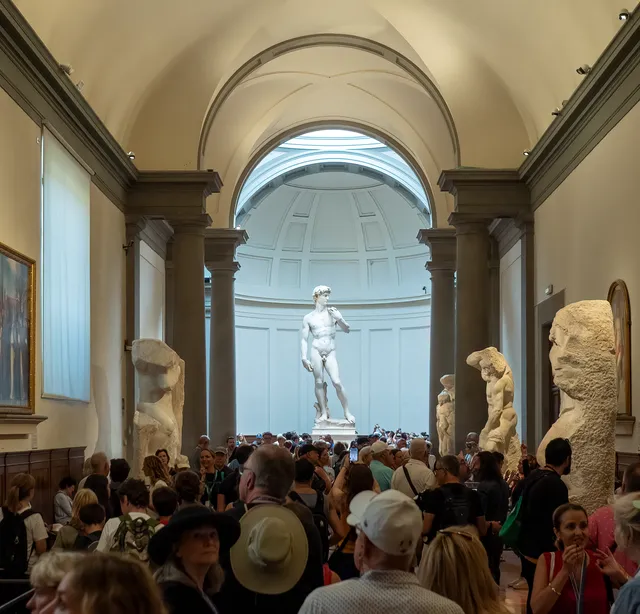
In 1873, after centuries of weathering, the David was finally brought indoors for its own protection. The chosen home was the Galleria dell'Accademia, the museum founded in 1784 as a teaching collection for students of the Accademia di Belle Arti. To receive it properly, the architect Emilio De Fabris designed a room to measure: the Tribuna, a luminous apse with natural light from above, opened to the public in 1882.
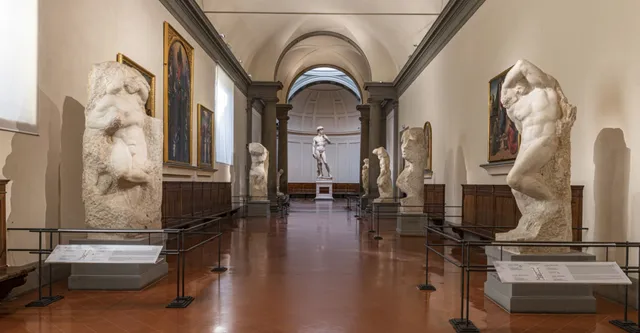
It is one of the first museum rooms in history built around a single work, and it still does its job: the skylight bathes the statue in a diffuse light that shifts with the hours and the seasons, and the approach corridor — the Galleria dei Prigioni — turns your arrival into a piece of staging. You see the David from far off, at the end of the perspective, and it grows with every step.
Room 04 · The work
What the David actually shows
Unlike earlier Davids, which showed the hero after the victory with Goliath's head at his feet, Michelangelo chose the moment before the fight. The sling rests on the left shoulder, the stone is hidden in the right hand, the body's weight settles onto the right leg. No trophies: just a naked young man sizing up his opponent, muscles still, mind already in motion. All the tension is in the gaze — fixed towards the left — and in the furrowed brow.
The "wrong" proportions — the head and right hand larger than life — are almost certainly deliberate: the statue was designed for the Duomo, to be seen from below and from a great distance, and the enlargement compensated for the perspective. From the floor of the Tribuna the effect nearly disappears; if you want to spot it, look at the right hand hanging at the hip, its veins standing out in relief.
The numbers, to pin them down: 5.17 metres tall, over five tonnes in weight, a single block of Carrara marble, three years of work between 1501 and 1504.
Want to see it in person?
The David is included in every entry ticket to the gallery. Pick a date and time slot with instant confirmation.
Room 05 · Conservation
The hammer of 1991 and the 2004 restoration
Four centuries outdoors left their marks, and the museum era has not been entirely quiet either: in 1991 a visitor struck one of the statue's feet with a hammer, damaging several toes before being stopped. The fragments were recovered and reattached, and surveillance in the Tribuna has been far tighter ever since — one of the reasons for the metal detector at the entrance.
In 2004, for the statue's five-hundredth anniversary, the David underwent a full restoration: a careful cleaning that removed deposits and dust and gave the marble back its glow. That is the version you see today: not a dazzling white, but a warm ivory that shifts in tone through the day under the skylight.
Room 06 · In the room
How to look at the David (without wasting the visit)
The most common mistake is to stop in front of the statue, take one frontal photo and move on. The David was made to be walked around, and the Tribuna lets you do it. A method that works:
- Arrive slowly. The corridor of the Prisoners (Prigioni) — the four unfinished figures carved for the tomb of Pope Julius II — is the perfect approach: barely roughed-out marble on either side, perfectly finished marble at the end. Don't rush through it.
- Do the full circle. From behind you can read the sling running down the back; the left profile shows the concentration in the face, the right the body's apparent calm.
- Find the eyes. From the front they seem to gaze into the distance; move to the left side and you catch their tense fixity — an athlete a split second before the sprint.
- Sit down. There are benches around the edge of the Tribuna: ten minutes seated are worth more than thirty on your feet among the tour groups.
As for photos: shoot freely, without flash. The natural light from above is at its best in the middle of the day; early morning, on the other hand, is when the room is emptiest. The two rarely coincide — decide whether you value the light or the space.
Room 07 · In practice
Tickets and tips for your visit
There is no "David-only" ticket: the statue is covered by any entry ticket to the Galleria dell'Accademia. At the ticket office the full-price ticket costs €20 (reduced €2 for EU citizens aged 18–25); booking online on the official channel adds a €4 fee, while authorised resellers such as Tiqets start at about €31 with priority entrance, at prices that vary by date. The full comparison is on the ticket prices page; if your only goal is to cut the wait, start with the skip-the-line tickets.
When to go
At 8:15 am, right at opening, the Tribuna is at its emptiest; the last usable slot is 6:20 pm. The museum is closed on Mondays: the full schedule is on the opening hours page.
How long
20–30 minutes to do the Tribuna and the Prisoners properly; 1–2 hours for the whole museum, which is compact but richer than it looks.
What not to bring
Large backpacks, helmets and bottles over 0.5 L are not allowed in, and the museum has no cloakroom. There is a metal detector at the entrance: travel light.
FAQ
Frequently asked questions
Why is the David at the Galleria dell’Accademia and not in the piazza?
The David stood outdoors in Piazza della Signoria from 1504 until 1873, when it was moved to the Galleria dell’Accademia to protect it from the weather. Since 1882 it has stood in the Tribuna, the room designed specifically for it by the architect Emilio De Fabris.
How tall is Michelangelo’s David?
The statue is 5.17 metres (17 feet) tall and weighs more than five tonnes. It is carved from a single block of Carrara marble, with no additions and no joins.
When was the David carved?
Between 1501 and 1504. Michelangelo received the commission from the Opera del Duomo in 1501, at the age of 26, and worked on the block for about three years.
Can you take photos of the David?
Yes, for personal use and without flash. The Tribuna is lit from above by natural light, so photos come out best in the middle of the day; a tripod is neither practical nor welcome in the crowded rooms.
Is the David in Piazza della Signoria the original?
No. The statue in front of Palazzo Vecchio is a marble copy, placed there in 1910 on the spot where the original stood for almost four centuries. The real David is only at the Galleria dell’Accademia.
Do I need a separate ticket to see the David?
No. The David is included in any entry ticket to the Galleria dell'Accademia: €20 full price, €2 reduced for EU citizens aged 18–25, plus a €4 booking fee for online reservations on the official channel. All the options are compared on the prices page.
Why do the head and right hand look too big?
They are almost certainly calibrated proportions: the statue was intended for the Duomo, so it was designed to be viewed from below and from a distance. Enlarging the head and hand compensated for the perspective. Seen from the floor of the Tribuna, the imbalance is barely noticeable.
How long does it take to see the David?
Allow 20–30 minutes for the Tribuna, including a full circle around the statue. The whole museum takes 1–2 hours: the route and the other rooms are covered in our guide to the Accademia's artworks.